
Real Friends
Eliza and the Bear
Friendship is a complicated, magical, frustrating, beautiful thing.
My friends are everything to me. I’ve been single nearly my whole life and for me that means I pour all of my love and need for connection into my platonic relationships.
It’s a big reason why romantic relationships scare me - the idea of having to give any of that energy to someone who isn’t one of my precious, perfect, angel friends? Incomprehensible.
But friendships are complicated. I already said that.
I’m saying it again, on purpose: friendships are complicated.
They don’t always mean the same thing to everyone. They aren’t relationships we’re taught to prioritize the way we prioritize family and romantic partners, even though they’re arguably the most important ones. The trope of your friend disappearing every time she gets a boyfriend? I don’t understand that and I frankly don’t have much patience for it.
I want my friends to value friendship as much as I do. I’ve been told that’s a big ask, but it mostly hasn’t proven to be. I have found people who value these relationships as highly as I do or even more so. And it’s one thing to say all this, to say that I value my friendships over nearly anything else, but it’s another to actually live it, and I’ve learned so much about what it looks like to be a good friend from my friends.
The wonderful, supportive friendships I have at this point in my life make me reflect on my own patterns as a friend and the ways they’ve shown up in past relationships.
Two books I read recently also made me reflect on those things: two stories that explored female friendships through wildly different lenses, each powerful and sensory and thought-provoking.
I wrote about (or rather, reacted to) Girl’s Girl by Sonia Feldman last week, with its shifting tectonic plates of teenage friendships in the humid cocoon of an Ohio summer.

The second book was The Divorceés by Rowan Beaird. At face value, the two books couldn’t be more different; The Divorceés is set in a different decade and climate from contemporary suburban Cleveland: the 1950s Divorce Capital of the world, the desert ranches and glamorous casinos of Reno, Nevada.
But both books were incredibly lush: there’s a reason my whole post about Girl’s Girl was a series of sense memories, a list of sweat-sticky, awkward adolescent moments frozen like an ice cream truck popsicle. The Divorceés is transportive too: descriptions of the ranch, the desert trail-rides, the dive bar, and the casino with its felt tables and sounds of clicking chips and cocktail ice.

Both books featured female friendships and their complexities when they bump up against one another and intertwine and get tangled.
In Girl’s Girl, the narrator Mina navigates her new romantic feelings for her friend Eleanor and the ways they impact her dynamic with their mutual best friend Margaret, with whom Mina has been inseparable since birth.
In The Divorceés, Lois spends six weeks at a “divorce ranch” in Reno with several other women who are all establishing residency in Nevada in order to file for divorce. There, she experiences the magic of female friendships for seemingly the first time. These friendships are different than what she’d known back home with the wives of her husband’s friends, who would only talk about “other wives who weren’t there, gossip as thin as powdered milk”. At the ranch, one of the other divorceés is a mysterious and magnetic woman named Greer and Greer sees something in Lois that no one else has.
“It seems impossible that Greer could feel that same recognition, not just as if they knew one another, but as if they were meant to know one another. Something connecting them that runs deeper than the surface similarities…that knit so many girls together.”
She gives Lois a certain confidence and permission to be whoever Lois wants to be. Greer teaches her to wear jeans and men’s linen shirts and says she’s like Katharine Hepburn. Greer gives Lois dares, opportunities to prove herself courageous and a little bit wild. Greer gets her and all the other girls to let go, to sit up on the bar together and smoke cigarettes and drunkenly serenade the men of Reno. It’s all so new to Lois and she “feels light as air, sitting a foot above everyone else in the bar, together with the girls in their separateness”.
I really thought that Greer and Lois’s relationship would end up being queer (and judging by StoryGraph reviews, I was not alone…
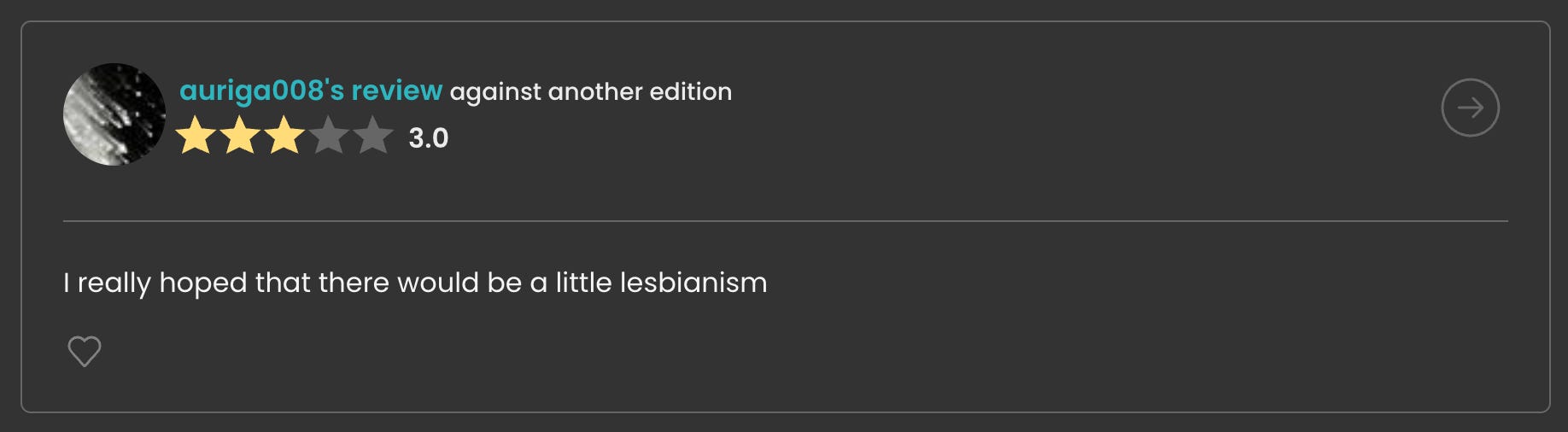
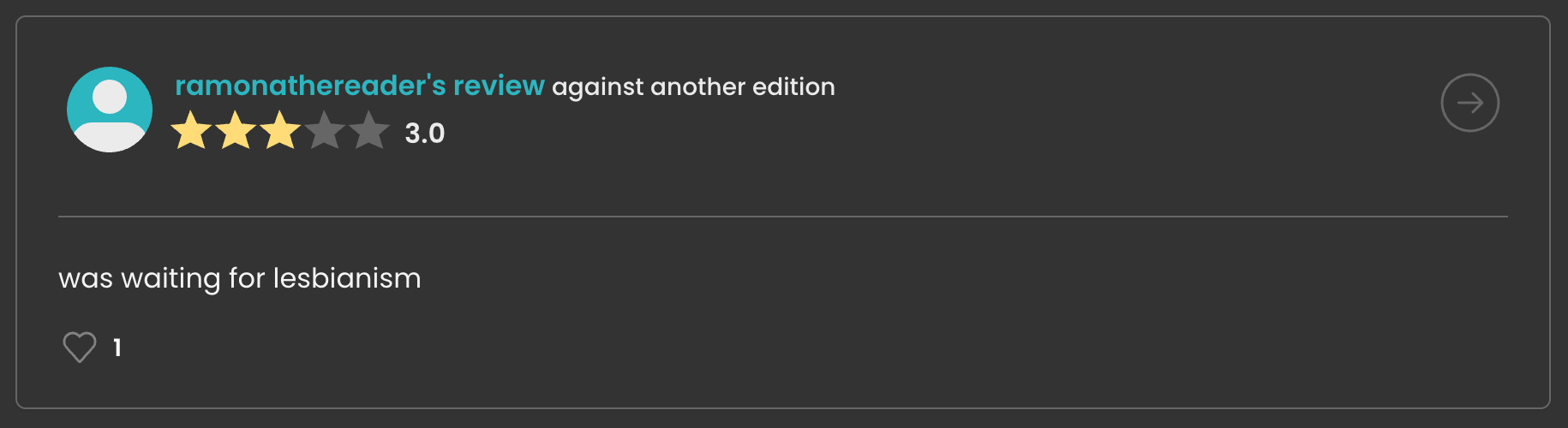

But what emerged from their relationship instead was actually more interesting to me, if not explored to its full potential: a Talented Mr. Ripley-esque dynamic of casual manipulation. I’m not sure how much the author meant for Greer’s manipulation of Lois to be premeditated and intentional, but my interpretation was that it wasn’t at first. My read was that Greer and Lois did have a genuine connection and Greer’s taking advantage of it was opportunistic.
Margaret and Greer are both different characters with different pulls on Mina and Lois respectively, but they both have that…✨thing✨. The thing that makes everyone turn and look when they walk into a room, like the temperature just spiked or the lights flickered on. The thing that makes you feel special because they chose you. Their attention is a gift to be bestowed and if you’ve received it, you shine a little bit brighter too. They’re these shiny, enchanting people who seem larger-than-life, which only makes their vulnerability feel that much more like a gift too. If they choose you to receive their imperfections and uncertainties, you are to be envied.
Both of these dynamics felt unsettling in their familiarity. I’ve had friendships that felt off-balance in a similar way. I spoke about this at length with a friend this weekend as we dissected our closest friendships and the patterns we both find ourselves falling into, so I know I’m not alone.
It’s something I loved about Girl’s Girl; Mina and Margaret’s friendship could easily have leaned fully into the toxic as Margaret let her extroversion and boldness swallow Mina whole. Instead, though that was certainly present, their dynamic ended up feeling real and warm. It was a complicated balancing act of a friendship between two girls with different needs and different ways they show up in relationships, who were both young and still figuring everything out, but who truly loved each other and wanted to be and do better.
In middle school and early high school, I had a few consecutive friendships that were all-consuming. These girls were black holes of emotional need. They were fun and charming and magnetic and their choosing me made me feel special. Their need was alluring.
I liked feeling needed. As a teenager with a sense of selfhood still under construction, it gave me a purpose: I existed to support these friends. When they were in crisis (often interpreted loosely), I was the eager recipient of passed notes in class and AIM messages only interrupted by demands to cede the family desktop computer (sorry parents <3). I was more ✨receptacle and untrained therapist✨ than friend.
I have no resentment towards these people, truly. They were also 13, 14, 15, searching desperately for identity and connection. I don’t really hold anything against anyone from under the age of like…20. But those dynamics did set me up with some patterns that have not served me well.
A friendship is by definition a two-way street. It requires mutual support and interest. And honestly, that mutual interest shouldn’t be a big ask. A friend is a friend in the first place because you both like each other, right?
Some of my closest friends to this day have, shall we say, strong personalities and I love that about them. They have big opinions and big feelings and they love to hold the spotlight. I would never want to dim any of that. (And I have my moments too. The spotlight is fun every so often!)
And it’s also true that those qualities sometimes lend themselves to a kind of self-centeredness that makes truly balanced friendship difficult. They can lead towards the Margarets or even the Greers of the world. When a friend is able to hold a full conversation on their own with no input required from you at all or when their style of conversation is to interrupt and make you fight for you place in it… well, it’s easy to take that as a verdict on your worth. If my friend who claims to love me is so uninterested in what I have to say that she’ll talk right through it, it’s easy to think that maybe what I have to say isn’t actually interesting at all.
I’m a people-pleaser and I’m independent to a fault. I want to give people what they need and I’ve historically been willing to be walked over for longer than I maybe should (see above re: patterns established as a pre-teen!). I also historically, when and if I’ve reached a breaking point, have been willing to move on because “I’m fine alone” and “I don’t need anyone who isn’t serving me”. (Convenient excuses for a coward!)
But I don’t want to be that person. I want to be someone who fights for my friendships, who demands better both because I deserve it and also because I want these relationships to last. Allowing myself to be a receptacle is not sustainable and I want friendships that are sustained. A one-way road will eventually become a dead-end.
I also now, by the age of nearly 31, have so many examples of healthy, safe friendships that leave me fulfilled and feeling like the best version of myself. I know what that’s supposed to look and feel like now in a way that I didn’t at 14. And, as hard as it is to rewrite narratives and patterns in established relationships, it’s something I’m very interested in working towards.
I want to be Mina and Margaret, working through an imperfect dynamic to get to something truer and kinder, rather than Greer who runs when things get messy. I want to be the Lois at the end of the book who uses the cash from her pawned wedding rings to move to LA and discover dreams she didn’t realize she had, not the version of her who was so relieved to be chosen by a person like Greer that she would betray her own instincts and abandon her integrity for her friend.
I think I deserve that and my friends do too. They deserve the chance to work on our relationship together, rather than having me make decisions for them based on patterns that they might not notice. If a friendship is a two-way street, I need to clear away my blockades and make space for the other lane to fix their potholes.
Thanks for reading, here’s a playlist for your time <3 it’s all about friendships <3 I love it when artists write about relationships that aren’t romantic because, if you’re doing them right, they can be just as meaningful and worthy of immortalizing in art <3
“Allowing myself to be a receptacle is not sustainable and I want friendships that are sustained.” !!!!!!
I love you and I love how you show up for your friends and yourself 🩷